
About Us
We bring antique sound into the modern world.
Our instruments are faithful recreations of historical woodwinds crafted using a unique blend of cutting-edge technology and skilled handwork. Each piece is 3D modeled from originals, printed in high-quality materials, then carefully hand-finished to meet the standards of both professional musicians and passionate beginners. Why 3D print historical woodwinds? Because it opens up new possibilities. You get the sound, look, and feel of the originals, without the fragility, cost, or long wait times of traditional craftsmanship.
Whether you're a student or amateur exploring Early Music, a performer needing a reliable backup, or just curious to try a rare instrument, our instruments are designed to be accessible, durable, and acoustically faithful. They're not replacements for traditional wooden instruments: we see them as companions. They make it easier to practice for long hours, travel, or experiment with historically accurate fingerings and tuning.
Each instrument is tested and fine-tuned by professional musicians before it leaves our hands.
From the past, made for today.
Take a look at what we do ↓

The Team
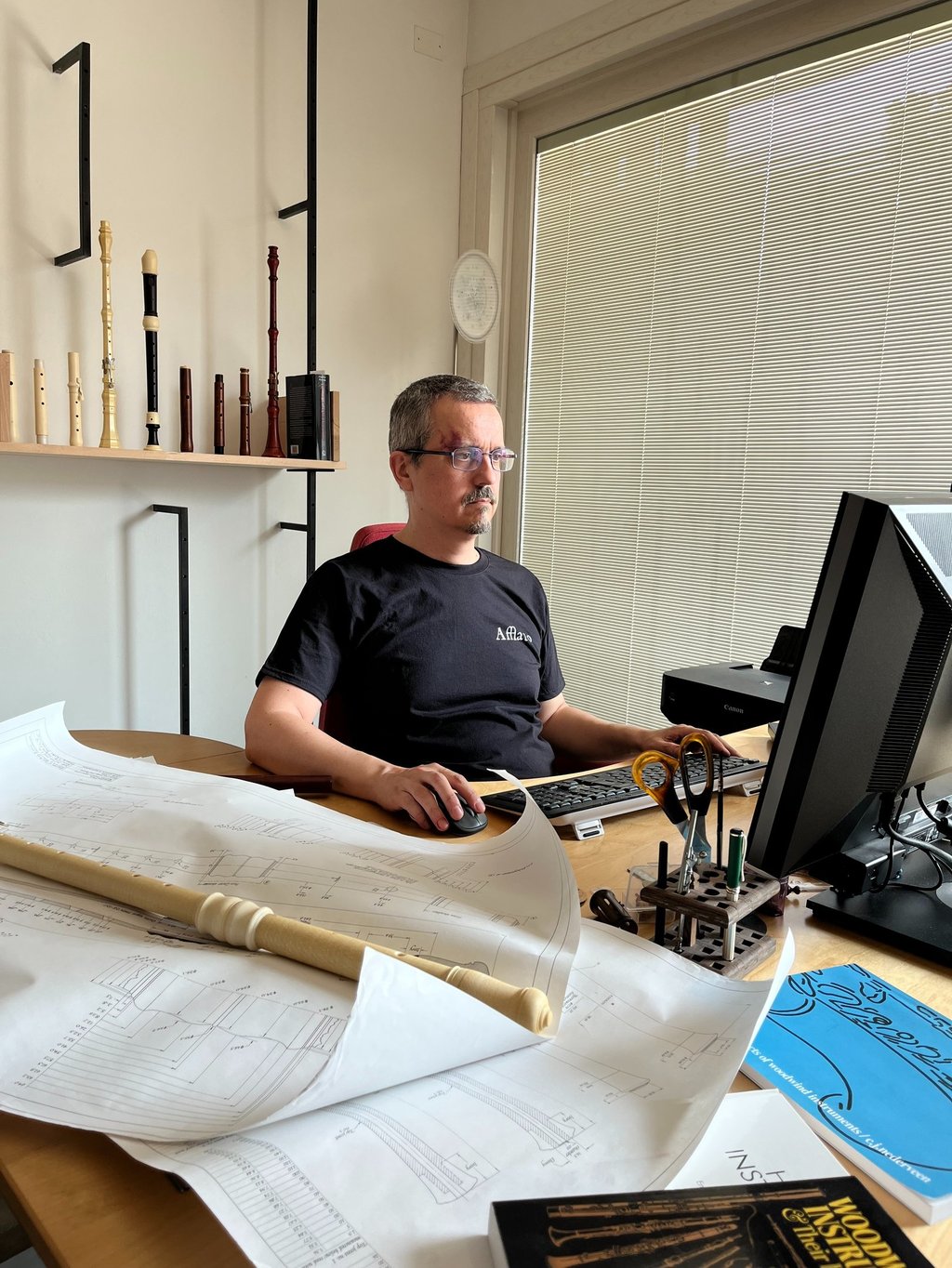
Federico Xiccato
Engineer by day, musician by night.
With a degree in modern flute and a background in engineering, Federico spends his days designing industrial machines and roller coasters and his evenings diving deep into Early Music. Over the years, he's studied the recorder, baroque flute, and renaissance cornetto, driven by a curiosity for the sounds of the past.
He brings together his love of architecture, math, physics, and antique instruments to create precise, playable replicas using advanced 3D modelling and printing. Federico has worked with institutions like the University of Turin and the Royal College of Music in London to recreate historical woodwind instruments down to the finest detail.
Oh, that recorder? By chance, I happen to be in possession of its technical drawing...
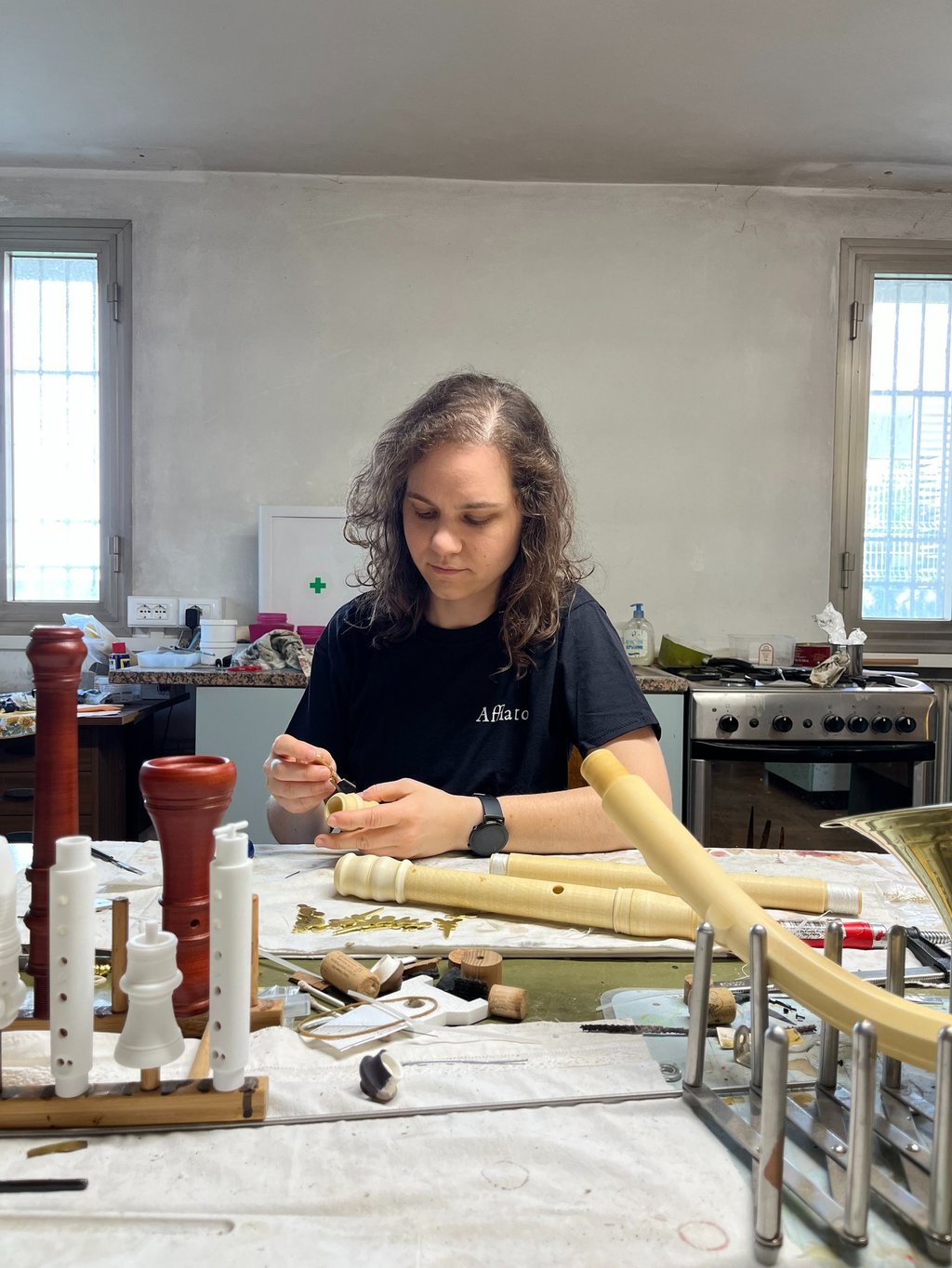
Caterina is a trained modern flutist with a background in accounting - proof that spreadsheets and sonatas can coexist. She has years of experience maintaining wind instruments and fine-tuning 3D-printed replicas to professional standards.
Caterina specialises in adjusting the delicate mechanics of both modern and historical winds, ensuring every key, spring, and pad is in perfect shape.
An axe, some oil, and WD40, that's all it takes.
Caterina Scapin
Flutist, fixer, finishing wizard.





Our Instruments
We craft accurate replicas of historical woodwinds, spanning from the Renaissance to the mid-19th century.
Our Materials
We use a carefully selected combination of materials for both the 3D printing and the hand-finishing stages.
Our Philosophy
Throughout history, makers of musical instruments have experimented with a wide range of materials, essentially all those that the technology of their time made available and that could serve the purpose for which the instrument was intended. This ongoing process of innovation, common to all areas of manufacturing in every era, has at times sparked controversy in the musical world. One need only think, for example, of the use of ebonite (hard vulcanized rubber) or metal (silver or nickel silver) in the construction of nineteenth-century flutes. Musicians have generally believed, then as now, that the material from which an instrument is made has a strong influence on its timbre. Acoustics and psychoacoustics have shown, however, that this is only partly true.
In acoustic string instruments, the vibration of the wooden resonating body is crucial to the production, transmission, and quality of sound. In wind instruments, and especially in woodwinds, by contrast, it is the air contained in the bore, the so-called “air column,” that vibrates. Its shape and fine geometric details determine the resonant frequencies, timbre, and differences among the various notes of the scale. Very small details, such as the geometry of the labium in a recorder or the flare angle of the embouchure hole in a traverso, can turn a mediocre instrument into an excellent one.
By contrast, the material of the casing that encloses the air column is relatively unimportant, provided that it is sufficiently rigid and smooth. Of course, the choice of material remains highly significant for many other reasons, such as weight, durability, ease of manufacture, long-term stability under varying environmental conditions, and, last but not least, the instrument’s aesthetic appeal. From an acoustic standpoint, the internal surface of the bore is particularly important, especially its roughness and its ability to transfer heat to the outside. These factors help explain the subtle differences that musicians and makers attribute to the various woods traditionally used in instrument making.
The twenty-first century has introduced a new technology for building wind instruments: 3D printing. Printing materials are polymers (plastics) with different compositions and mechanical properties which, when shaped according to appropriate geometries, can yield excellent musical results. While this idea may be readily accepted in the context of folk instruments or clearly innovative designs, it can seem almost heretical when applied to so-called “classical” music, long anchored to nearly sacred standard repertoires and to technological solutions dating back more than a century. It may appear even more radical in the field of early music, where the focus is on producing replicas of instruments for Renaissance, Baroque, Classical and early Romantic repertories.
The key challenge, then, is to determine whether the major advantages of 3D printing can be harnessed to create instruments of a quality comparable to that of traditional craftsmanship in wood and brass. The first decade of experimentation in this area has produced highly encouraging results. When properly designed and manufactured, these instruments are attracting growing interest both in organological research and in the teaching of early music, as well as in professional performance practice. Numerous psychoacoustic tests carried out with expert listeners, including professional musicians and students, show that “plastic cannot be heard.” Two instruments of the same model, that is, copies of the same original, one made of wood and the other 3D-printed, are not easily distinguishable by ear.
For those of us who have been working in this field for many years, this no longer comes as a surprise. We are nevertheless always amused by the reactions, ranging from disbelief to enthusiasm, of those who hear or try these 3D replicas for the first time. As in any field, detractors are not lacking, and their criticism is in fact the most valuable tool for identifying which production and finishing processes can still be improved.
Why 3D print historical instruments?
There are many reasons, and they extend well beyond the practical advantages offered by printing technology itself. In particular, it has long been understood in the field of organology that there are two truly revolutionary technologies: computed tomography (CT) and 3D printing. These two techniques go hand in hand, since they work in synergy to produce geometrically highly faithful replicas of an original instrument, making it possible to reproduce every detail. This includes features intentionally created by the maker, those resulting from the intrinsic properties of the original materials, such as various woods, ivory, bone, horn, brass, silver, and others, as shaped by mechanical processing, and finally the details produced by use of the instrument and by the degradation of the materials themselves. These include rounded edges, deformations, cracks, ovalizations, reductions in tenon diameter caused by thread wrapping, and so on.
All of this body of information, collected through tomography and incorporated into the 3D model, makes it possible to obtain replicas that are virtually identical to the original, naturally within the limits of accuracy and precision allowed by the technologies themselves. This first of all makes it possible to have study instruments available as substitutes for the originals, on which extensive acoustic and, above all, musical experimentation can be carried out. It is well known that original instruments in museums can only be played for very short periods of time, and in the case of the most valuable or oldest examples, they cannot be played at all. Researchers and makers can therefore rely on extremely valuable faithful copies in order to investigate the qualities of the original, to isolate which aspects of degradation truly affect sound quality, and to study tuning and temperament in detail.
Tomographic images (essentially radiographic slices taken in every conceivable plane) can on their own provide the researcher with information that traditional measurement techniques can obtain only approximately, if at all. This includes precise bore profiles, internal anomalies caused by localized interventions by the maker or by damage over time, and detailed geometries of tone-hole chimneys, transverse flute embouchure holes, recorder windways, and so on. While the availability of tomographic information is extremely valuable, it is not strictly indispensable for producing good 3D replicas. Traditional measurement techniques, such as calipers and go/no-go gauges, if used correctly, can also yield measurements of sufficient quantity and quality to generate an effective 3D model, from which a replica can then be produced using 3D printing.
Our Workflow
The typical workflow is as follows:
Collection of measurements from the original: manual measurements, radiographic images, computed tomography, and optical scans.
Design of the 3D model based on the measurements, using commercial 3D CAD software. If a tomographic dataset is available, the reconstruction of the 3D geometry is carried out using dedicated reconstruction software that directly produces a 3D model.
In cases of severe degradation of the original (chipping, cracks, extreme ovalization, significant axial deformations), the 3D reconstruction obtained from tomography is usually followed by a meticulous process of “virtual restoration.” This consists of locally modifying the 3D geometry (mesh) by closing cracks, reconstructing any missing parts (a typical case being a chipped recorder labium), straightening sections that have become curved or “banana-shaped,” and correcting obvious deformations such as constrictions at the tenons, and so forth. Another significant modification to the original geometry may also be introduced, if desired, namely scaling the instrument to shift it from its original pitch standard to one of the standard pitch levels introduced by the early music revival (415 Hz, 392 Hz, 440 Hz, 430 Hz, 466 Hz), so that the replica can be used in present-day practical musical contexts.
Once the 3D geometry of the instrument has been created, the next step is 3D printing. At this point, a wide range of possibilities opens up. The current market offers a broad spectrum of printing technologies, from low-cost, home-based fused filament fabrication (FDM), through stereolithography based on the polymerization (that is, chemical linking) of liquid resins into a solid form, to laser sintering of powders (SLS) and resin–ceramic composites. These latter are high-quality technical materials, with correspondingly higher costs, widely used in mechanical engineering. Metal keys can be produced either by traditional handcrafting from sheet metal, or by 3D printing in metal (stainless steel, brass, bronze, or silver) based on digital files.
Each of these materials has advantages and drawbacks, and the choice among them depends on the intended goals. In strictly organological research, where the priority is to maximize dimensional accuracy and minimize human intervention in order to obtain a “digital twin” of the original artifact (as it has come down to us and been preserved to the present day), stereolithographic resins or resin–ceramic composites tend to be preferred. These materials allow faithful reproduction of even the finest details of the instrument, but they are very expensive and have a high density, which makes them poorly suited to producing instruments that are practical to use. At the opposite extreme, home filament printers can produce low-cost prints with moderate accuracy and often more than acceptable musical results, provided that the underlying geometry is correct. Intermediate in terms of cost and accuracy is powder sintering technology, carried out with specialized industrial machinery. This produces semi-finished parts of excellent precision, but they cannot be used as printed because they are naturally porous and relatively rough. They require a craft-based finishing process, both internal and external, to make the surfaces suitable for their function as a casing for the vibrating air column. This finishing process typically also includes aspects related to the instrument’s aesthetics and durability.
From the standpoint of acoustic performance, the different technologies and materials employed can yield instruments that differ significantly from one another in sound quality, ease of response, and intonation. In general, 3D printing offers good repeatability, meaning that repeated prints of the same model produced using the same technique are usually very similar to one another. This intrinsic objectivity and repeatability are among the main reasons why organological research has embraced this technique. Any subsequent artisanal intervention introduces a human element into the printed object, along with a small degree of variability that can subtly differentiate each individual copy.
Collaborations
The success of this entire process is ensured by the collaboration of many people with different areas of expertise. We regularly ask professional musicians to try our instruments and always seek their opinion on the quality of the results. When a musician raises doubts or criticisms about a replica, we take the opportunity to extract useful insights for improving the product. These suggestions often point toward making a replica better suited for use in today’s professional musical contexts, and therefore concern pitch standard, temperament, ease of response, ergonomics, key mechanics, durability of finishes, and similar aspects. Some suggestions lead in unexpected directions. From a historical model there may emerge, through appropriate modifications and simplifications, a good educational instrument that can help today’s teachers introduce students to historically informed performance practice. In all cases, we remain careful not to go too far with modifications, so that the fundamental qualities of the replicas remain as close as possible to those of the originals.
Museum curators, with their historical and organological expertise, can also make an essential contribution in the initial phase of developing a new model. The collections of major museums around the world certainly include instruments of exceptional musical value, but also mediocre examples, or instruments unfortunately badly damaged by use and time. Choosing a good original to work from, and in which to invest hundreds of hours of work and significant financial resources in order to obtain a first 3D prototype, is therefore a matter of great importance. Careful examination of catalogues and study of the technical surveys produced over decades by those who preceded us in the study of these precious objects allow us to rule out in advance many originals that present problems incompatible with a successful replica. There are beautiful instruments, visually striking and made of luxurious materials, that nevertheless lack the acoustic qualities needed to make them good candidates for replication. This initial analysis and selection of possible candidates is carried out in collaboration with experts, particularly musicians who have had the good fortune to play these originals, and can therefore provide precise first-hand assessments.
We have also been fortunate to establish fruitful collaborations with traditional makers of wooden replicas. Among them we remember above all our dear friend Pietro Sopranzi, who over the years devoted countless hours to us in his workshop, sharing essential elements of his professional practice. On his part, this was an investment aimed at enriching us with his knowledge, motivated purely by the pleasure of sharing his craft, and finding in us interlocutors able to stimulate his curiosity toward cutting-edge technologies and the latest developments in organological research. To Pietro in particular we owe our affectionate remembrance and our gratitude for having taught us so much about the secrets of recorder voicing.
An Unsuccessful Prototype
One of the first flutes we attempted to replicate in 3D was the beautiful ivory original by Jacob Denner preserved at the Nuremberg museum (catalogue no. MI566). This instrument stands out for the magnificence of its workmanship and for the distinctive feature, rare for an instrument of its time, of having both a D foot and a C foot. These characteristics made it appear extremely appealing, and we attempted a replica based on technical drawings provided by the museum. The prototype required many hours of work, both at the computer and in the workshop, and we still clearly remember the excitement of trying the finished instrument and measuring its pitch, which turned out to be 408 Hz.
That, however, was where the joy ended. The replica sounded irredeemably bad, especially when using the C foot. We asked the opinion of several flautists, all of whom confirmed that it was a problematic instrument. The friends with whom we were collaborating daily at the time, the chemist Gabriele Ricchiardi from the University of Turin and the flautist Manuel Staropoli, nicknamed the prototype “the shelf ornament.”
A retrospective investigation of this flute then began, and we came to the conclusion that our initial choice had been hasty. Apparently the original was not regarded as an instrument of great musical value, and those who had played it had formed a rather mediocre impression. Moreover, the technical drawing supplied by the museum lacked important information about acoustically essential details, such as the internal geometry of the bushing and the chimneys of the finger holes. During the design phase, this forced us to fill in the missing information based on our own assumptions. Our inexperience led to a disappointing 3D geometry, despite the considerable effort invested.
We consider that early misadventure extremely valuable for everything it taught us, and for having compelled us to reflect critically on every aspect of the process of replicating an original: the original itself, its state of preservation, the historical information gathered by organologists, the documents describing it, the quality and quantity of geometric surveys, and the judgment of musicians. Nor do we consider that experience concluded. We would like to return to that project in order to understand fully whether the original instrument is truly so flawed, perhaps due to degradation or later alterations that compromised it, or whether it was the lack of information in the drawing that doomed the experiment to failure. If we succeed in having that original instrument subjected to tomography, we will certainly have far more information on which to base a high-quality replica.
Afflato
HISTORICAL WOODWINDS
3D-printed | hand-finished
Castelfranco Veneto, Italy
info@afflato.com