
Dulcians, Bassoons & Racketts
Renaissance/Early Baroque Dulcian
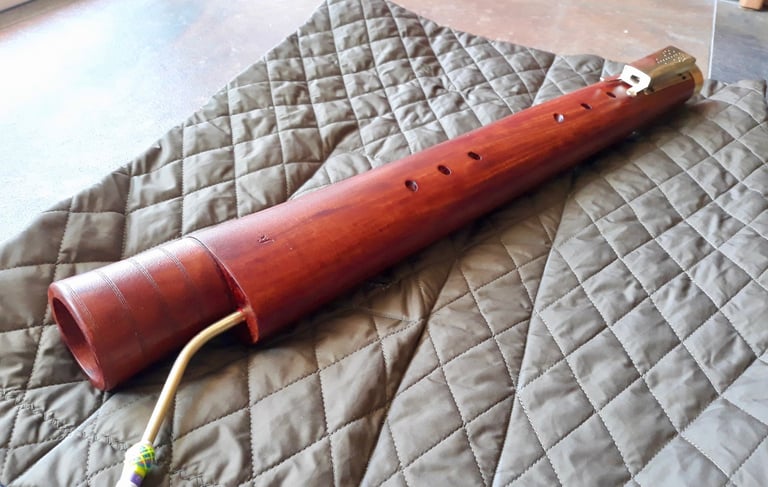
The dulcian (or curtal), the direct predecessor of the bassoon, was developed in the 16th century and remained in use until the late 17th century, making it an ideal choice for Renaissance and Early Baroque repertoire. Its compact size and relatively simple handling also make it an excellent introductory instrument for young bassoon students.
Our modern reconstructions, available at A=440 Hz with two keys, are based on surviving originals from the Maximilian Museum (Augsburg) and the Sammlung Preussischer Kulturbesitz (Berlin).
True to historical practice, we offer the dulcian as a complete family of instruments, including soprano (in C), alto (in F), tenor (in C), and bass (F). The tenor is available both with a single key (F) and with a double key (F and F#).
J. H. Eichentopf Baroque Bassoon
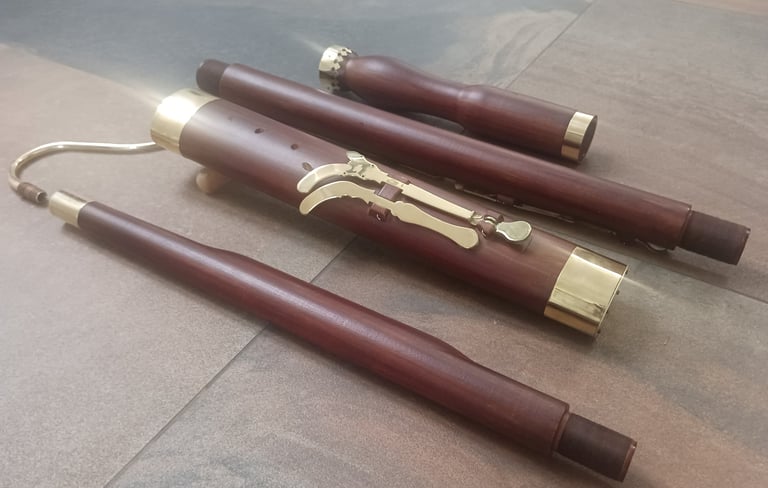
The two surviving bassoons by Johann Heinrich Eichentopf are among the most copied and widely used models in historically informed performance today. In addition to their excellent playing qualities, they adapt well to A=415 Hz. Moreover, Eichentopf, active in Leipzig in the first half of the 18th century, is closely associated with the musical environment of Johann Sebastian Bach.
For our model, we selected the well-preserved original housed in the Landesmuseum in Linz (cat. no. Mu35), dated to around 1730. Our replica follows this instrument closely and features a 5-key configuration: the four original keys (G♯, F, D, B♭) and an added E♭ key for improved practicality.
W. Wijne Baroque Rackett in F
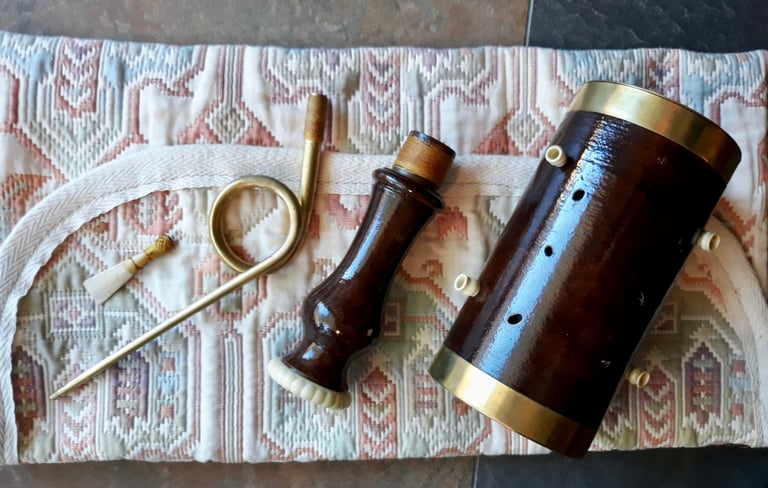
The baroque rackett is a fascinating and unusual instrument: its conical bore is folded multiple times and fitted into a wooden cylinder—an ingenious design that earned it the German nickname Wurstfagott, or “sausage bassoon”. Despite its compact form, it plays at the same pitch as a bassoon, making it a practical and portable alternative for both continuo and solo repertoire.
Our model is based on a high-pitched original by Willem Wijne, active in Nijmegen (The Netherlands) in the second half of the 18th century, now housed in the Musikinstrumenten-Museum, Berlin (No. 064). It was reconstructed from a technical drawing and scaled to A=440 Hz.
Afflato
HISTORICAL WOODWINDS
3D-printed | hand-finished
Castelfranco Veneto, Italy
info@afflato.com